lscgid: execve():/home/xboxexcl/public_html/cgi-bin/body/rside.cgi: Permission denied
|
 |
 |
 |
 |
 |
|
WOW Entertainment
|
Sega
|
Racing
|
1-2
|
09.05.02
|
Sega GT 2002
Sega GT; Sega's answer to Gran Turismo, is something you would likely have
never imagined to come out of the company responsible for games like Seaman
and Rez, but at the same time, are amazed how well they pull off the
sim-racer style. This, the 2002 incarnation of their ill-fated Dreamcast
title Sega GT, has finally earned some of the critical and consumer
acclaim it rightfully deserves, and genuinely gives Gran Turismo a run for
it's money.
Gameplay
Probably the most prevalent of the original's problems were point blankly
involving the games control; the most important aspect of any self
respecting driving simulator. Many felt the game controlled sloppily and was
unresponsive, and some would say they were right. But shedding that memory
aside, SGT2002 completely reinvents the series, sporting a totally reworked
engine (don't mind the pun), turning 2002 into a legitimate contender for
the sim racer crown.
What Sega has done here, is turned the wheels-of-soap physics of the
original title upside down, changing slip-sliding turns into precise tests
of reaction and timing, which the current king of the genre --Gran Turismo--
introduced, changing the way the genre was viewed when it first hit the
scene. That said, can Gran Turismo's very invention be one-upped by Sega,
who is essentially using GT's own formula in hopes of striking similar
success?
Well now, let's not get ahead of ourselves, is Sega really following a
beaten path? Or is SGT2002 really more than it's cracked up to be?
When you get right down to it, SGT2002 in actuality isn't given the credit
it deserves, because while it certainly abstains to Gran Turismo's
definition of a sim-racer in many ways, from the real licenses (ranging from
Japanese manufacturers like Toyota and Mitsubishi, to American and European
companies like Ford and Jaguar) and and true-to-life cars, SGT2002 is almost
entirely different in the biggest area; how the game plays.
Some may consider SGT2002's physics a bit more arcade-like when compared to
GT because GT focused on much stiffer physics, but this is entirely not the
case. In reality, SGT2002 just controls more intuitively, truth be told
(which could be somewhat attributed to the Xbox's analog stick). For
instance, Gran Turismo found you more often than not resorting to quick taps
to the dpad for most turns, almost coasting into your turns for you, where
as SGT gives you much more swing in your movement, requiring you to always
be paying attention to how the weight of your car is distributed, keeping
your turning ratio in mind, and of course your speed and brake resistance.
All of this going into the gameplay certainly makes SGT cars more compelling
to drive, and more importantly, adds much more strategy to how you plan your
turns.
Adding further strategy to each race, SGT adds something else to the formula
in form of a damage bar for your car. How the damage bar works is pretty
self explanatory; for each race, you're given a full bar, and as you hit
walls or other cars, you take damage, decreasing your damage bar. It's
purpose is apparently to give you further incentive to actually drive the
course realistically, as the more damage you take, the less money you're
given for winning a race. However, the incentive works both ways, because if
you can finish a race without a scratch to your car, you're rewarded
additional money. The damage bar certainly accomplishes it's job, as you'll
definitely be vieing for the extra reward in every race, but I can't say
that the damage bar doesn't get rather annoying on occasion.
Now differences aside, one thing both sims share is the upgrading and
tweaking of your cars. Like in GT, SGT gives you many options in upgrading
your car, from mufflers and tires, to weight reductions and suspension
upgrades, all of which noticeably improve your car's performance. Many of
the parts also offer the ability to fine tune the part exactly to your
specifications, whether you like a softer suspension or a higher camber
angle. Upgrading certainly isn't taken lightly in SGT either, you'll
definitely need a fully upgraded car if you want to even compete with cars
of similar or better standard. The main difference between GT and SGT in the
upgrade department however, is that parts you purchase in SGT (a few of them
at least) always need to be kept in top shape, as they slowly deteriorate
after races, and in the case of buying used parts, can actually fail on you
mid-race (yes, you read that right).
Once you've come to gripes with the gameplay, you'll be put to the test in
SGT's two main modes; the (aptly titled) Sega GT 2002 mode, and the
Chronicle mode. The former is SGT's equivalent of your simulation or career
modes of other titles, and in it is likely where most of your time will be
spent. What the mode revolves around are official races (SGT's licence test
mode, where you complete a series of races in order to compete in each
consecutive licence test), and event races (which are of no real
accomplishment-value aside from being where you earn the majority of your
money). The game advances as you complete each licence test, after which the
money you win for each event race is increased and the opposing drivers get
better cars (though sadly, once you've earned an NSX or better, you're
really not going to have any competition in this mode).
The interesting part of Sega GT 2002 mode though, isn't so much the buying
of new cars, but the addition of a garage that you can call your own, which
you can decorate with the various cups you earn from official races, and the
dozens of items you can buy to put in it (as well as pictures of your race
replays, which you actually take yourself). Don't expect any creative
control though, sadly everything you can buy gets it's own designated area
of the garage, but even so, it's a cool little addition, and proves fun to
collect everything for a while.
Once you've played out the Sega GT 2002 mode though, you'll still have the
Chronicle mode to play around in. The Chronicle mode is basically Sega's way
of paying it's respects to the classic cars of yester-year. Chronicle mode
finds you picking between a variety of cars from the '60s and '70s to race
in a series of chronologically increasing races, and as the years increase
between each race, so too do the model cars of your opponents, so at the end
of the series, you'll actually be going toe to toe with Lotuses and Lancers
while sitting in your measly Honda S600 (though the game definitely gives
you a big handicap in most of these races). In the end, Chronicle mode is
fun for what it is, but it's more a realization of what we've come from,
rather than what we had.
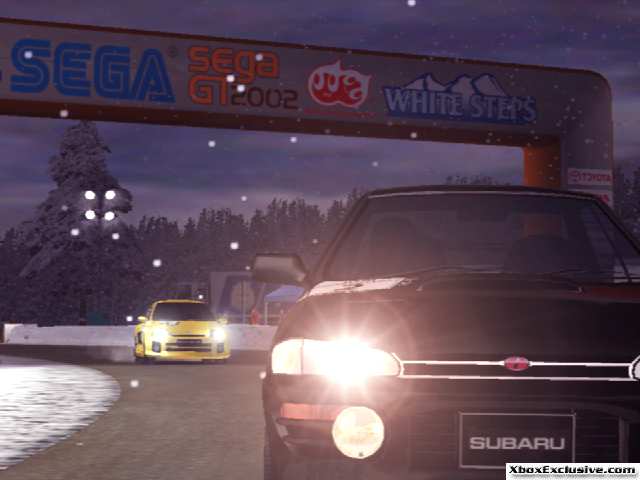
Graphics
Now certainly the gameplay of any game is the most important aspect of it,
but as it is with racing sims, the graphics are a very important part of the
puzzle as well, considering the works of art that they're so accurately
trying to portray, and in SGT things are no different. That said, SGT is an
extremely strange graphical bag, because while the game looks very good in
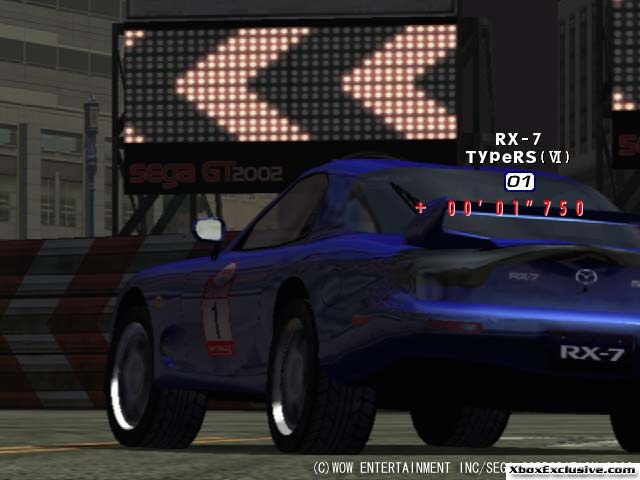
many places, it also fails that in many places. For example the car models
in SGT are exceptionally well done, with noticeably much larger poly models
than Gran Turismo 3, featuring very detailed and fully modeled curves and
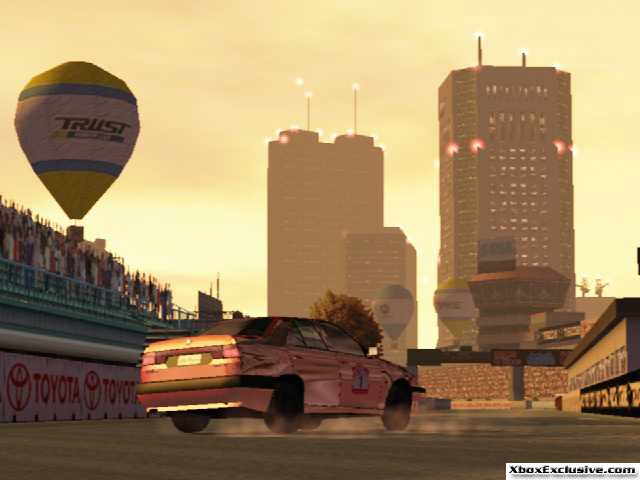
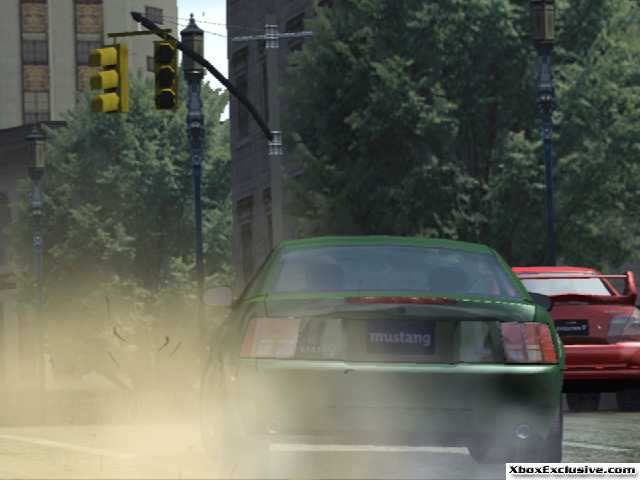
crevices. On the other hand, the ground textures and many of the backgrounds
in the game are fairly lackluster and bland, especially considering Xbox's
specialty in textures (where's the bump-mapping Sega!?).
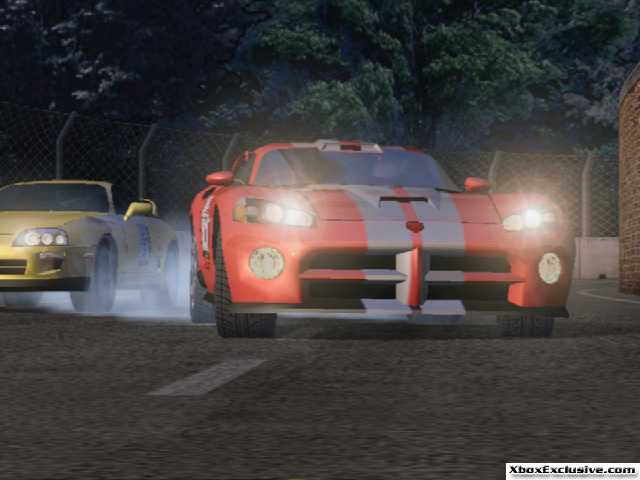
You can definitely tell the attention was put into the car models, and they
really shine (literally), sporting beautiful in-game background reflections
and very impressive heat and sun reflection. The game also suffers from an
unusually large case of the jaggies, and just looks much grainier than GT3
(despite PS2's notoriously jaggie inducing hardware). Not to look down on
PS2 in anyway, but I honestly wouldn't be surprised in the least if SGT was
initially in development for PS2 and switched over to Xbox during
development (for reasons which will remain nameless ;)).
Sound
The sound department of SGT falters a bit, sadly, as most of the music found
in the game falls in either the jazz-themed menu category or generic
synthesizer-driven racing music, which was probably all done fairly quickly
in-house at Sega. Thankfully, Xbox's custom sound track ability saves
another XB racer's soundtrack from mediocrity, letting you rock out to
whatever taste floats your boat. The sound effects in SGT aren't exactly
much better, though they're certainly not bad. Engine sounds and screeching
tires sound authentic enough, and provide a suitable racing atmosphere.
Bottom Line:
When all is said and done, Sega GT 2002 is a very competent racer that finds
itself on a console with many superb ones. It's certainly a very good game,
and if you've had your fill of the rest of XB's driving line-up, it'd make
for a great addition to your library. As for SGT being the Gran Turismo
killer, all I'll say, is that GT easily beats SGT in polish and variety,
where SGT, in my opinion, wins when it comes to the actual gameplay. Take
that for what you will, but however you take it, give SGT a chance --you may
be pleasantly surprised.
-Andy Wilson



lscgid: execve():/home/xboxexcl/public_html/cgi-bin/body/rbottom.cgi: Permission denied
|
|